
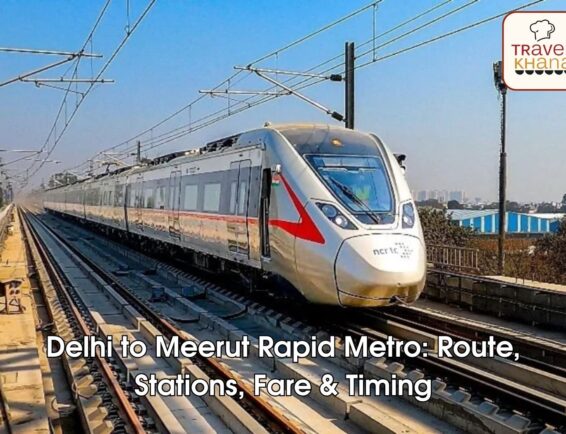
Delhi to Meerut Rapid Metro: Route, Stations, Fare & Timing
Travel between Delhi and Meerut is set to become faster, smoother, and far more comfortable with the launch of the Delhi to Meerut Rapid Metro. This ambitious regional rail project is part of India’s first Regional Rapid Transit System (RRTS). The project aims to reduce travel time dramatically while improving connectivity across the National Capital Region (NCR).
The Delhi to Meerut Rapid Metro is now fully operational, allowing passengers to travel between the two cities in less than an hour. Currently, road journeys often take two to three hours depending on traffic conditions. Therefore, the rapid metro system is revolutionizing daily commuting for thousands of passengers.
What is the Delhi to Meerut Rapid Metro?
The Delhi to Meerut Rapid Metro is a semi-high-speed regional rail corridor developed under the Delhi–Meerut RRTS project. The corridor will connect Delhi, Ghaziabad, and Meerut with modern high-speed trains designed for comfortable intercity travel.
The rapid metro trains will operate at a design speed of 180 km/h, with an operational speed of around 160 km/h. Because of this high speed, commuters will experience a significant reduction in travel time compared to road transport.
Moreover, the trains will offer modern facilities such as comfortable seating, air conditioning, luggage space, and advanced safety systems.
Delhi to Meerut Rapid Metro Route and Stations
The total length of this corridor is approximately 82 kilometers. It will connect key locations across Delhi, Ghaziabad, and Meerut.
Major stations on the route include:
- (Z00) Sarai Kale Khan
- (A01) New Ashok Nagar
- (A02) Anand Vihar
- (A03) Sahibabad
- (A04) Ghaziabad
- (A05) Guldhar
- (A06) Duhai
- (A07) Murad Nagar
- (A08) Modi Nagar South
- (A09) Modi Nagar North
- (A10) Meerut South
- (A13) Shatabdi Nagar
- (A17) Begumpul
- (A21) Modipuram
Sarai Kale Khan in Delhi will serve as the main hub where passengers can easily connect with other transport systems including the metro, railway stations, and bus terminals.
Because the stations are strategically located, this corridor will benefit both daily commuters and occasional travelers.
Travel Time Between Delhi and Meerut
One of the biggest advantages of the corridor is the dramatic reduction in travel time.
Currently:
- Road travel takes 2 to 3 hours depending on traffic.
With the rapid metro:
- Travel time will reduce to about 55 minutes.
This improvement will help professionals who commute daily between Delhi, Ghaziabad, and Meerut. It will also boost economic activity across the region.
Furthermore, the high frequency of trains will ensure that passengers do not have to wait long at stations.
Expected Fare for Delhi to Meerut Rapid Metro
The fare structure of the Delhi to Meerut Rapid Metro is expected to be higher than the traditional metro but significantly cheaper than private taxis or cars.
The final fare for the complete journey between Delhi and Meerut is ₹210, depending on the class of seating. The trains will also feature standard and premium coach options, allowing passengers to choose their preferred level of comfort.
Modern Features of the Rapid Metro Trains
The trains used for the Delhi to Meerut Rapid Metro will feature advanced technology and passenger-friendly amenities. These trains are designed to offer a modern travel experience similar to international rapid transit systems.
Key features include:
- Fully air-conditioned coaches
- Comfortable seating arrangements
- Mobile charging points
- Wi-Fi connectivity
- CCTV surveillance for safety
- Automatic doors and modern signaling systems
Because of these features, passengers will experience a comfortable and secure journey.
Impact on NCR Transportation
The Delhi to Meerut Rapid Metro will significantly improve connectivity across the National Capital Region. Faster transport will encourage people to live in satellite cities such as Meerut while working in Delhi.
As a result, the project will reduce congestion in Delhi while promoting economic development in nearby cities.
Additionally, the rapid metro system will help reduce road traffic and vehicle pollution. Therefore, it will contribute to a cleaner and more sustainable transport network.
Food Options for Travelers
While rapid metro journeys are shorter than long-distance train trips, travelers often look for convenient food options before or after their journey. This is where services like TravelKhana can be useful for passengers traveling by rail across India.
If you are traveling via train and need food, simply visit www.travelkhana.com or download the TravelKhana App. Enter your PNR number, browse restaurant options, and order meals that will be delivered directly to your train seat at the selected station.
TravelKhana offers food from top brands and restaurants across 400+ railway stations and 100+ airports, making travel more comfortable and convenient for passengers.
Conclusion
The Delhi to Meerut Rapid Metro is one of the most important transportation projects in North India. With faster trains, modern stations, and reduced travel time, the rapid rail corridor will transform the way people commute between Delhi and Meerut.
As the project progresses toward full operation, thousands of commuters are expected to benefit from faster, safer, and more reliable transportation. Ultimately, the Delhi–Meerut Rapid Metro will strengthen regional connectivity and support economic growth across the NCR.